Authors:
Kristi MukkPublished:
The Perma team recently attended the International Internet Preservation Consortium’s (IIPC) Web Archiving Conference, held this year at the KBR—Royal Library of Belgium in Brussels. A recurring theme was that web archiving depends on collective stewardship of the open-source tools, institutions, and people that make preservation possible. At a moment when the web is becoming more difficult to archive, the conference offered an assessment of current challenges and a reminder that the sustainability of the field relies heavily on collaboration and shared responsibility.
The opening keynote panel—“Sustainability for Open Source Web Archiving Tools”—brought together perspectives from libraries, consortia, and open source service providers: Lauren Ko (University of North Texas Libraries), Tessa Walsh (Webrecorder), Neil Jefferies (Open Preservation Foundation), Yves Maurer (National Library of Luxembourg), and LIL’s very own Clare Stanton (Perma.cc). The conversation focused on the structural pressures now reshaping the digital landscape, and what collective stewardship might realistically look like. Key takeaways from this conversation are outlined below.
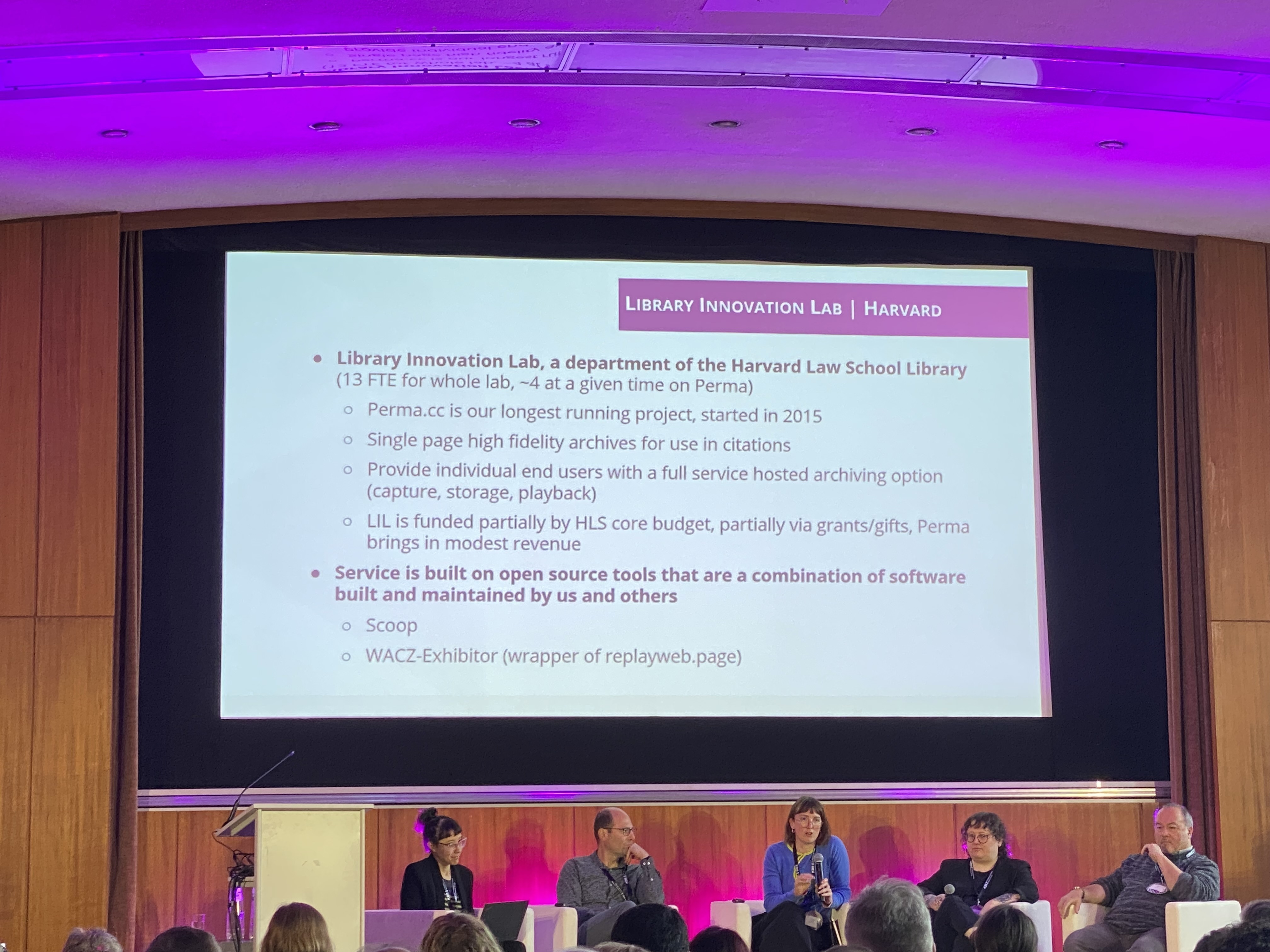
Clare Stanton (center) discusses Perma.cc during the opening keynote.
Need for sustained investment in open-source software
The web archiving community no longer has the luxury of treating tool and infrastructure maintenance as someone else’s problem. Nearly every institution in the room relies on these open-source tools, including Perma itself. For example, the replay functionality for Perma.cc is built on replayweb.page, part of the software suite developed by our long-time collaborators at Webrecorder. Despite almost everyone using these open-source tools, almost no one is funding them proportionally. Historically, many projects survived on grants and foundation support, but that funding landscape is shrinking. Yves framed open-source work as a shared mission and responsibility, especially for national libraries and cultural heritage institutions whose mandates depend on long-term stewardship. Institutions should be contributing back to the web archiving ecosystem they depend on.
An asymmetric fight against a complex and closing web
Web archiving has become more difficult in the past few years, and the scale and pace of change is only accelerating. Tessa described the current environment as an “asymmetric fight” due to bot detection and anti-scraping systems increasingly treat archiving crawlers the same way they treat commercial scrapers. Several panelists pointed to the collateral damage caused by large-scale scraping and large language model (LLM) training. Infrastructure providers are tightening access controls across the web, often in ways that make legitimate archival crawling significantly harder. Tessa noted that archivists now need to spend more time simply observing crawls to determine whether captures succeeded or whether crawlers archived nothing but bot verification pages. Clare suggested that the closing web may create an opportunity for archiving institutions to advocate collectively for differentiated treatment, making the case to infrastructure companies like Cloudflare that preservation work serves a fundamentally different purpose from commercial scraping.
Beyond single maintainers: Sustaining people, not just code
The panelists repeatedly returned to governance and community structure as equally important to technical capability, and also discussed the human labor behind open source tooling. Multiple panelists emphasized that storage and compute are not the primary costs in web archiving operations. The expensive part is retaining highly skilled people capable of adapting tools to a rapidly changing web environment. Neil argued that sustainability problems become especially acute when projects depend too heavily on single maintainers. The goal, Neil suggested, is not to remove human dependency, but to move from person-dependent systems to people-dependent systems, with succession planning, multiple technical leads, and stronger organizational support structures.
Digital preservation as collective responsibility
There was some cautious optimism about potential sources for more sustainable support. Panelists discussed adding funding requirements for upstream open-source projects into public tenders for web archiving services, creating institutional budget lines specifically for open-source maintenance, and treating contributions to community software as legitimate professional development work for developers within libraries and archives. Some panelists pointed to growing interest in digital sovereignty policies in Europe, where governments increasingly want more direct control over digital infrastructure and collections stewardship. Yves suggested that this political shift could create opportunities for open-source preservation tooling, particularly if public sector procurement rules begin explicitly rewarding contributions back to shared infrastructure.
Benefits and limitations of AI-assisted coding
Not surprisingly, AI hovered over much of the discussion. AI-assisted coding may reduce some development overhead, and some panelists described productive uses for code review, bug detection, and scripting assistance. However, the panel was skeptical of the idea that AI meaningfully solves the underlying sustainability problem. Faster code generation does not automatically create maintainable systems, healthy governance, or resilient communities. As Tessa noted, velocity without understanding creates its own risks.
Open-source software is critical preservation infrastructure
The key takeaway that emerged from the opening keynote was a reframing of open-source web archiving infrastructure not as ancillary technical tooling, but as critical preservation infrastructure. The field behaves as though these systems are indispensable, but there is a significant underinvestment in open-source tools. The harder question, and the one the panel kept circling back to, is whether institutions are willing to fund, maintain, and steward them accordingly.