Author:
Molly HardyPublished:
The following remarks were delivered at the National Summit on Local News Preservation on June 17, 2026.
News is, with few exceptions, place-based. “Where” is one of the journalist’s first questions, and without it, news feels groundless, baseless, unmoored. But news used to not only be written from a specific place, but also written for the people living in that specific place. In that sense, all news used to be local. But whether the news reported on immediate surroundings, the colony or state, the nation or empire, the function of newspapers was to provide a public record, both for audiences at the time, and for future readers. In fact, many editors were conscious of this function of the newspaper as a repository; some two hundred years ago, they provided, in the words of Hezekiah Niles in his prospectus for Baltimore’s Weekly Register, “something interesting at the present moment, and as a book of reference, a fund of reading always at hand, a work of much probable value” (September 7, 1811).* Newspapers were, from their earliest days, understood as a public good, as “work[s] of much probable value.”
Information has been mobile from its early days — from the troubadour to the telegraph, one might say — but because “news” is the sum of information plus time, or timeliness to be more exact, the accelerated speed of transmission is vital to the rise of news for national and international audiences. Most scholars agree that syndicated news really took hold after the Civil War with Chicago’s A.N. Kellogg Newspaper Company. As with our own moment’s undervaluing of local news, the transition away from “local” newspaper-reading audiences did not happen overnight and cannot be attributed to a single factor. Infrastructure, — in the nineteenth century, the railroads and stereotype printing; today, the internet and social media — combined with sociocultural shifts, makes the world feel smaller.
We are gathered here today to celebrate and to concern ourselves with news that does not move, that stays more or less in the place from which it came. It is, as Lincoln would say, “altogether fitting and proper that we should do this,” for reasons beyond the present moment. As an historian, I have been tasked with adjusting our gaze ever so slightly from the “now” to the “back then.” I’d like to draw out a few examples of the importance of local news in historical research in the hopes of showing, rather than telling, not only that historical local news matters, but also that we must retain its understanding of itself as a public good. Without this printed record, it is easy to forget that it is not just people who have history, but places too. Without the context of place, history too feels groundless, baseless, and unmoored. I fear that the history we are creating today might not even exist in a century from now, but I will say more about that later.
When we think of historical newspapers, we often think of the people whose lives they capture, and perhaps even the lives of the people who produced them. We might even think of the stories they omit, of the people not represented in these wilted and worn pages. More recently, environmental history has helped us to see historical newspapers as the place to uncover the histories of the land, as the sources that will shed light on the social and cultural causes of global warming and environmental degradation. The research and storytelling in the work of scholars and journalists alike are changing how we think of newspapers and the vital role they play in understanding the histories, and in turn, the futures of our environment. Corporate archives often do more to conceal than to reveal, if one can gain access to them at all. Government records can be little better. But, local newspapers contain the stories written by the local intrepid reporter who cites evidence of a paper mill’s destruction of the river running through the town. Similarly, where official records might have denied harmful contamination from Superfund sites, a historian can scan obituaries for evidence of untimely deaths from cancer clusters. We need local newspapers to read against official narratives told of the land, as well as of the people who inhabit it.
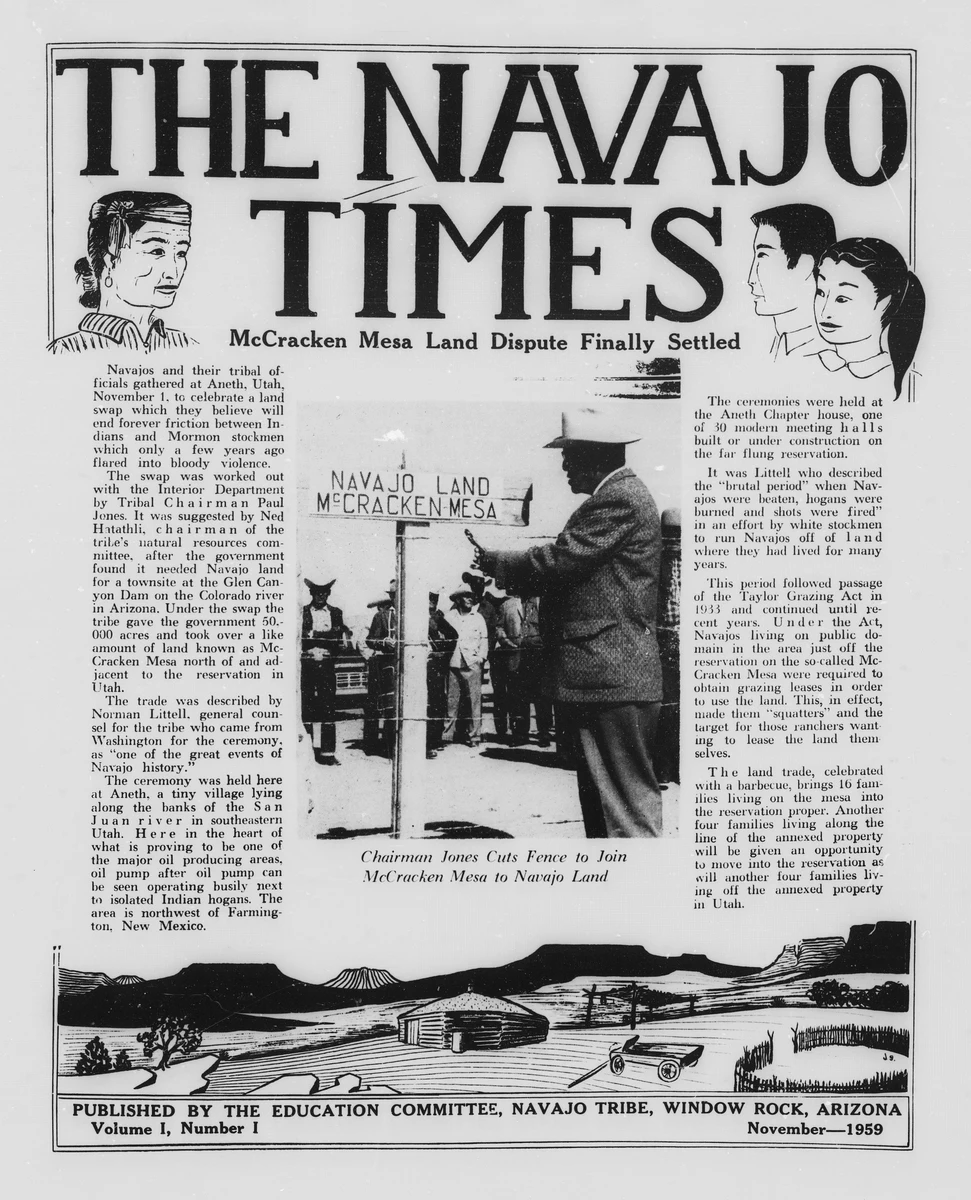
Think, for example, of the hyperlocal newspapers published on reservations, such as the first newspaper published in the Navajo language in Window Rock, Arizona. The Navajo Times’s purpose, as stated in its inaugural issue in 1959, was “to serve the 6,000 Navajo children who are attending off-reservation schools. It is hoped that this newspaper will keep them informed about what is happening on their reservation. It is also hoped that this is a step toward supplying the Navajo people with an ever-increasing flow of information.” This paper then was to keep the local — the power of place — in the hearts and minds of its intended audience, no matter where they went, or were forced to go. This statement of purpose from the Navajo Times is a gentle reminder that people are, in part, defined by place, and the stories they told of “the local” have much to teach us today.
Aggregation of Historical Local News, a National Prerogative
As a researcher, I have been privileged to be a consumer of local news, and as a former senior program officer at the National Endowment for the Humanities (NEH), I was also a producer, managing the National Digital Newspaper Program (NDNP), the NEH program that funds and co-creates Chronicling America. Chronicling America does and does not serve the preservation of local news. As of my most recent check, it includes 4,684 newspaper titles and over 3 million issues, dating from 1736 to 1963. These titles certainly include a handful of “local newspapers,” no matter how that category is defined. And yet, this was not the intention of NDNP. In fact, for about the first 15 years of its existence, NDNP inadvertently discouraged the preservation of “local” newspapers by encouraging applicants to begin with papers of record, with those that had long runs, and most likely, were published in big cities intended for large audiences. Because so many of the states have by now contributed these “major” papers, the program shifted, in 2021, to newspapers that tell underrepresented histories. Until recently, applicants were welcome to define “underrepresented” in any way they chose, and they often chose place-based representation (see the 2024 Notice of Funding Opportunity (NOFO); “underrepresented” has been expunged from the 2025 NOFO). More and more newspapers from neglected areas were being included in Chronicling America. Without empirical evidence to back me up, I would venture that there has been a rise in “local” if not “smaller” newspapers in Chronicling America in recent years.

And yet, the resource will always fall short, for it cannot provide all that we are looking for. Those who designed it, back in the early 2000s, knew this. They knew that the 1963 cutoff date for inclusion would exclude many important papers, and they knew that many state partners were able to digitize far more newspapers than could be included in the national aggregator. And so, the genius of NDNP is not only what you find in Chronicling America, but also in the way that it established standards for newspaper digitization. Its hope was that Chronicling America would be just one of the manifestations of the work it enabled; states would also become aggregators of their newspapers, using the same standards. And they have done so, creating amazing state-level digital newspaper repositories, such as Georgia’s Historical Newspapers or the Texas Digital Newspaper Program, just to name a few. Such state-level efforts were encouraged to reuse content digitized for Chronicling America, as well as to include that which did not make it to the national aggregation level. CONSERV cataloging and the technical guidelines for digitization demonstrate that standardization must be part of the work of preservation; otherwise, the “local” risks being relegated to the dustbin of history. If we believe that “local” does not mean “less than,” then we must use the same standards for categorizing and making accessible local newspapers that we do for the so-called “papers of record.”
Local News as Public Data
The term “dark ages” has grown out of fashion for historians because it suggests that no light existed in the period from 500 to 1000 CE. Painstaking scholarship has slowly uncovered that this is not the case, that in fact people were innovating, creating, and exploring in ways not all that different from classical antiquity before it and the Renaissance afterwards. And, yet, the label “dark ages” resonates today, not because our current moment is failing to produce meaningful and innovative work, but because of the great difficulty the future will face in tracing the lives and outputs of the people of our moment. As Jonathan Zittrain has pointed out, the internet, which for better or worse houses much of our current culture’s memory and creativity, is “rotting.” Technologies that once signaled a great unfurling of access to information are now showing cracks and vulnerabilities when considered at a historical scale. The historical record of the current moment will be, in many ways, “dark.” We are in what might be referred to as the “digital dark ages,” not because important things are not happening, but rather because the future’s light on this moment is diminished, if not snuffed out completely.
We have been asked this morning to address what “getting local news preservation right” would require, and my response is that we must provide multiple ways to shine light on our current moment. Data is the new oil, or so we’ve been told for the last two decades, and I roll my eyes at this metaphor not because it is not true, but because data is so much more than a market commodity. Local news, in its many forms and instantiations, is public data, and we must preserve it because it has an inherent value that surpasses our current moment, that is so much more than its commodification. Because we cannot see the future, we cannot know all of these values, but based on our reliance on historical “local” newspapers to know the past, we can trust that they exist.
For the most part, libraries exist outside of the naked self-interest of capitalism, and the people who work in them must play a role in the preservation of local news. Librarians are the original public interest technologists, we might say, and I urge us to put them at the forefront of our conversations here. Journalists too exist in a space not completely captured by market forces, and they too want information to be free and to be accessible. I see an alchemy emerging from the alliance between these two professions that offers future generations not only a historical record of their communities from which they can analyze and learn, but also a model for forms of affinity and alignment that exceed capitalist logics and exemplify other modes of cooperative work. This gathering is an important step in this effort, and I am honored to be a part of it.
* Thank you to my friend and collaborator Will Slauter for providing this example and for his assistance with these remarks throughout.